
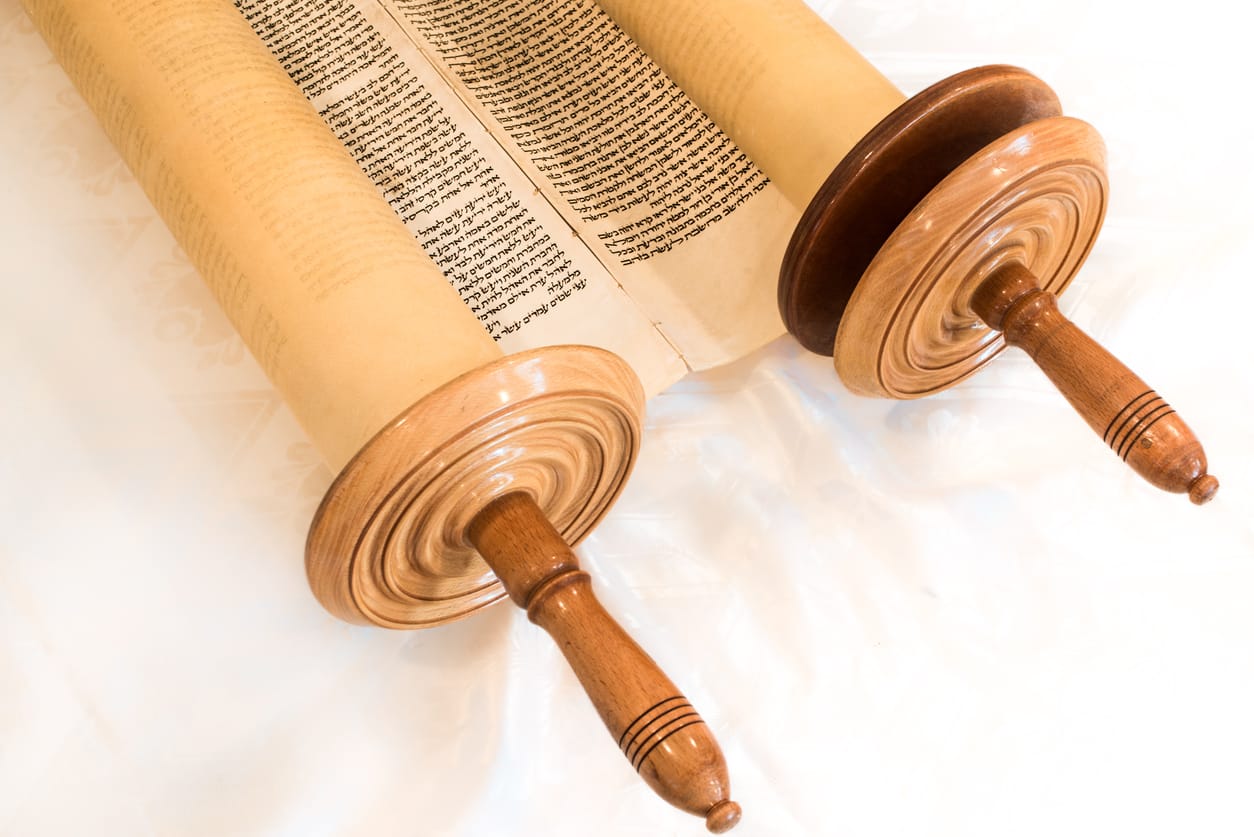
What is the Torah?
Judaism is centered around the Five Books of Moses in the Bible, otherwise known as the Torah. In traditional Judaism, it is believed that this was written by G-d and provided to Moses to give to the Jewish people. It contains many basic precepts and societal norms which are considered integral to modern welfare. Many of the ideas commonly found in society today, revolving around fairness/equity, basic compassion, cleanliness/hygiene, and vacation time, among others, originated from the Torah. It is a common practice to study a little bit of the Torah each week, reading through and pondering each section (or parshah) in detail, over the course of the Jewish year. When we finish the entire Torah (commemorated by the holiday Simchat Torah a couple weeks after Yom Kippur), we start again, as there are always new lessons to learn and to question, and classic lessons to re-affirm.
The Holiday Torah Portion: A Deeper Dive
On Rosh Hashanah, we read a special portion of the Torah, two stories centering around Abraham, known as one of the patriarchs of the Jewish people. We study them in detail and can always learn something new, as well as re-affirm one of the many reasons we are faithful to a divine G-d. Just this year, I observed new questions that I had never thought about before, and it gave me a brand new perspective on one of the Torah teachings.
The Birth of Issac
The Torah parshah first discusses the miraculous birth of Issac to Sarah, Abraham’s wife, (Ch. 21:1 – 34). Earlier in Ch. 17:15 – 19, G-d prophesied to Abraham that Sarah would conceive and bear a son, even at her old age of 90 years. “…I will give you a son by her…Sarah your wife shall bear you a son, and you shall name him Issac…” Abraham had strong faith in G-d, even though he was surrounded by pagan peoples who worshipped many gods. But this was an unheard-of feat: a 90-year-old woman, previously barren her whole life, would finally bear a child? Nevertheless, in Ch. 21:1 – 2, the next year, “[t]he Lord took note of Sarah as He had promised, and the Lord did for Sarah as He had spoken. Sarah conceived and bore a son to Abraham in his old age, at the set time of which G-d had spoken.” Abraham literally saw the result of G-d’s miracle.

The Binding of Issac
When Issac was approximately a teenager, G-d asked Abraham to travel with Issac to a nearby mountain and do the unthinkable: offer his treasured son as a sacrifice. In those times, this was not an uncommon deed performed by neighboring pagan peoples. But Abraham was the first to believe in a monotheistic religion, in one G-d who is loving and compassionate. The Bible then tells how when they travel to their destination, Issac asks what the sacrifice is to be, and Abraham responds (Ch. 22:8), “G-d will see to the sheep for His burnt offering, my son.” Abraham actually binds Issac on an altar, and slowly lifts his hand to slay his son, to be suddenly stopped by an angel of G-d. This angel tells Abraham (Ch. 22:12), “…Do not raise your hand against the boy, or do anything to him. For now I know that you fear G-d, since you have not withheld your son, your favored one, from Me.” A ram appears in the thicket nearby, and Abraham joyously sacrifices the ram instead.

What is the true purpose of Abraham’s test?
This second story is usually told to remind us of Abraham’s unwavering faith in G-d and desire/willingness to serve G-d, no matter the duty given. The reason is solely that G-d is our Father in Heaven, the being who created us and who looks out for us. It is however, a difficult story to hear; how could any of us imagine going forward with an action that would destroy our beloved child? G-d is a loving and benevolent G-d. Why would He ask this? We know that Abraham must have been absolutely heartbroken to hear this instruction, and was almost certainly experiencing every moment with a sorrow that would be too much to bear. Yet he had such love for G-d that he was willing to offer the thing he loved most as a gift.
As I mentioned above, this year I was given a question to ponder: What was the test Abraham was given? This sounds like a simple question with a simple answer. However, a few new thoughts occurred to me.
- How much faith would Abraham have, even though he was faced with an impossible request, that somehow things might still work out? He actually should have supreme faith, because he already had witnessed a miracle at the hands of G-d, Issac’s birth, specifically foretold by G-d. Would he believe that a miracle would happen again?
- Abraham had witnessed a miracle created by G-d, so he knew G-d’s power. However, Issac had not necessarily gained first-hand knowledge of G-d’s deeds at that time. We are much more likely to believe in something once we experience it ourselves. Perhaps this was partly a plan to help Issac’s faith solidify, as it was physically happening to him.
- G-d asked Abraham to offer Issac as a burnt offering. However, it isn’t clear that the offer is to be actually accepted. Perhaps he is to simply be willing to offer, with G-d never having any intention of actually taking the offer. Abraham would have to trust: would G-d accept the offer and take Issac, or would the offer be politely declined? Until the moment of the actual offer, Abraham doesn’t actually know.
- As mentioned earlier, child sacrifice was common among the surrounding peoples. Perhaps this was meant to also prove to them that G-d will indeed provide, and would certainly prefer to have a ram rather than a child sacrificed.
What else is hidden in the story? Read very carefully…
If we read the Torah portion, we see that it doesn’t discuss in detail the conversation between G-d and Abraham in which G-d puts forth this request (Ch. 22:1 – 2). “Some time afterward, G-d put Abraham to the test. He said to him, “Abraham,” and he answered, “Here I am.” And He said, “Take your son, your favored one, Issac, whom you love, and go to the land of Moriah, and offer him there as a burnt offering on one of the heights that I will point out to you.” That is all; it doesn’t delve any further into this conversation. Why might it not add further details? Wouldn’t Abraham have asked for clarification, to be sure he had heard correctly? Wouldn’t Abraham have pleaded, begged, even argued with G-d? Most of the time Abraham was G-d-fearing; but in Ch. 18:23 – 32, he actually argued with G-d, asking Him to spare the wicked towns of Sodom and Gomorrah if there were but 50 good men residing there.
We see that we must not necessarily just take the Torah strictly at face value. We are to think about the meaning behind the words. Take a look at these particular verses (emphasis added):
- Ch. 17:16, “…I will bless [Sarah] so that she shall give rise to nations; rulers of peoples shall issue from her.” (note it says “nations” and “peoples,” plural)
- Ch. 17:19, “G-d said, “Nevertheless, Sarah your wife shall bear you a son, and you shall name him Issac; and I will maintain My covenant with him as an everlasting covenant for his offspring to come.”
- Ch. 17:4: “As for Me, this is My covenant with you: You shall be the father of a multitude of nations.” (note it says “nations,” plural)
G-d had already said that Issac would grow to have offspring. Abraham would have known that G-d would not go back on His word. He would have seen that he must not doubt, that even with such an unimaginable request, G-d would in the end not actually take his beloved son. He had to have faith that, even if it seemed like it would come to pass that Issac would die, even at the last possible moment, G-d would intervene and stop his hand in time.
Takeaway
So we can see that there’s always more to the Torah lessons than we might at first think. This is why we read and re-read the Torah year after year, studying it to remind ourselves of its lessons, and contemplating new ideas not yet ruminated. It is a book of morals and is our guide to being better people.
For related reading, check these out:
Sources referenced and utilized:
Note: The book titles below include affiliate links to Amazon. This simply means that any purchases through these links may generate a small commission for us, at no cost to you. As an Amazon Associate I earn from qualifying purchases. More info can be found in our full disclaimer here. I personally own all of these books, consulted them for this article, and highly recommend if you’re interested in further learning. Thank you for your support!
JPS Hebrew-English Tanakh: The Traditional Hebrew Text and The New JPS Translation, Second Edition. The Jewish Publication Society. 1999.
Jewish Literacy: Revised Edition. by Rabbi Joseph Telushkin. William Morrow, HarperCollins Publishers. 1991, 2001, 2008.
The Jewish Holidays: A Guide and Commentary. by Michael Strassfeld. William Morrow, HarperCollins Publishers. 1985, 2001.
chabad.org: a wealth of information regarding all things Jewish, with an Orthodox/modern Orthodox point of view.
Cover image photo credit: IStockPhoto.com/ollega