The Days of Awe, commencing on Rosh Hashanah and ending on Yom Kippur, mark a period of intense reflection and renewal. We contemplate our actions from the past year, resulting in a renewed determination to be a better person in the new year. Rosh Hashanah and Yom Kippur together are called the High Holy Days and are the most observed holidays in American Judaism; if a Jew doesn’t celebrate anything else, he/she usually observes one or both of these two holidays.
Rosh Hashanah: The “New Year”
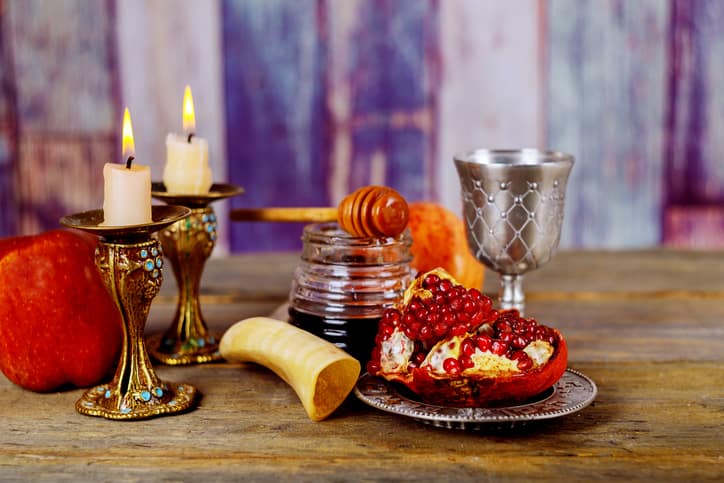
On Rosh Hashanah, we celebrate the anniversary of the Creation of the world, as told in Genesis, 1:1 – 2:4. Many Jews typically do not go to work on this day; as it is said in Numbers 29:1, “In the seventh month, on the first day of the month, you shall observe a sacred occasion: you shall not work at your occupations.” [The Jewish calendar begins just before Passover in the springtime; however, the anniversary of Creation takes place in the fall, and that is designated as Rosh Hashanah.] Some denominations will observe the holiday over two days instead of one. Holiday candles are lit at sunset the preceding night (all days on the Jewish calendar begin at nightfall and go through the next dusk). We may go to synagogue around sunset and/or in the morning of the holiday. Jews will also commonly eat yummy sweet things such as apples dipped in honey and wish each other a “sweet New Year.” The ram’s horn, called a shofar, is always blown to remind us of the importance of the day; as it is said in Numbers 29:1, “You shall observe it as a day when the horn is sounded.”

For the next week after Rosh Hashanah, we examine our actions from the past year. We think about times when we have behaved badly and when we have wronged another, or when we may have disappointed G-d. If we have wronged someone in any way, we are to make amends and ask for forgiveness.
Yom Kippur: The Day of Atonement
Yom Kippur falls nine days after Rosh Hashanah (eight days if you observe Rosh Hashanah for two days). On this day, we acknowledge all the possible ways we may have done wrong in the eyes of our fellows or G-d, and we renew our commitment to do better.
During Yom Kippur, to fully focus on our resolve, Jews again refrain from going to work and commonly fast from sunset to sunset. As it is said in Numbers 29:7, “On the tenth day of the same seventh month you shall observe a sacred occasion when you shall practice self-denial. You shall do no work.” Traditional Jews will also refrain from things such as wearing perfume or moisturizers, bathing for pleasure, wearing leather shoes, and sexual relations. We are to afflict ourselves; repentance and remorse come more easily when you’re in a bit of discomfort.
The holiday candles are again lit at sunset, and many Jews will go to a special evening service, Kol Nidre. It is known for its melancholy melody (usually involving a cello) and a renunciation of any vows made during the year which have been unfulfilled. Services are offered in the mornings as well, and many Jews will attend Torah study sessions during the day. A special service called yizkor is performed in the late afternoon; this involves prayers that are said for our parents who have passed on. Evening services close out the holiday, along with the sound of the shofar.
A common visual noted during the High Holy Days is that during Rosh Hashanah, the gates of Heaven open, and the Book of Life decreeing everyone’s destiny opens its pages. G-d looks down on us as the truest Judge of our innermost being and decides our fate based on our deeds. At the end of sunset on Yom Kippur, the gates close, and our fate is inscribed and sealed in the Book of Life for the year.

Takeaway
The High Holy Days are some of the most life-affirming days in the Jewish calendar. Each year, we take time to think about how our actions affect others. We pause to remind ourselves of all the ways we might, even unintentionally, hurt others. We re-affirm our sense of compassion and actively renew a commitment to be better members of society. Each year holds new possibilities; it is up to us to try and be the best contributors we can be.
For related reading, check this out:
Sources referenced and utilized:
Note: The book titles below include affiliate links to Amazon. This simply means that any purchases through these links may generate a small commission for us, at no cost to you. As an Amazon Associate I earn from qualifying purchases. More info can be found in our full disclaimer here. I personally own all of these books, consulted them for this article, and highly recommend if you’re interested in further learning. Thank you for your support!
JPS Hebrew-English Tanakh: The Traditional Hebrew Text and The New JPS Translation, Second Edition. The Jewish Publication Society. 1999.
Jewish Literacy: Revised Edition. by Rabbi Joseph Telushkin. William Morrow, HarperCollins Publishers. 1991, 2001, 2008.
The Jewish Holidays: A Guide and Commentary. by Michael Strassfeld. William Morrow, HarperCollins Publishers. 1985, 2001.
chabad.org: a wealth of information regarding all things Jewish, with an Orthodox/modern Orthodox point of view.
Cover image photo credit: IStockPhoto.com/photovs





Thanks for explaining the holidays! And I appreciated reading your thoughts about the story of Abraham and Isaac. It pretty much lines up with considerations I’ve heard in church classes or talks about this, including Isaac not being a little child and Abraham having already been promised that through Isaac, he would have many descendants. I recently read this story to Matt as part of scripture study, and that was one of the tough stories to read to a child who doesn’t believe. But, but but but – I appreciate hearing a similar understanding from another person of faith. 🙂
Just noting that the section with the Torah study has been moved to a separate post! https://thejoyfuldabbler.com/torah-thoughts-the-high-holy-days/