Learn about the basics of the Festival of Booths, or Sukkot: its biblical origins, how it’s celebrated, and the meaning of the sukkah hut. A quick intro to Simchat Torah follows.
The season of autumn is quite a busy one in the world of Judaism. The High Holy Days are among the most well-known set of holidays in the Jewish faith (see my previous post here); even many who are not Jewish are cognizant of them. However, a lot fewer people outside the Jewish circle are aware of the holidays that follow. Observant Jews participate in a whirlwind month of activity, starting with Rosh Hashanah and Yom Kippur, followed by the holidays of Sukkot and Simchat Torah.
When and What is Sukkot?
Sukkot follows five days after Yom Kippur in the fall. It is a holiday celebrating the harvest, in essence, a “fall festival” for religion. We show our gratitude to G-d for the bountiful food we receive by agricultural means. As it is said in Leviticus Ch. 23:33 – 34, “The Lord spoke to Moses, saying: Say to the Israelite people: On the fifteenth day of this seventh month there shall be the Feast of Booths to the Lord, [to last] seven days.” And Leviticus Ch. 23:39, “Mark, on the fifteenth day of the seventh month, when you have gathered in the yield of your land, you shall observe the festival of the Lord [to last] seven days…”
As part of the holiday, we also remember how the Jewish people wandered through the desert after the Exodus from Egypt (for a summary of the Exodus, click here – this commemorates the classic story of Moses and the deliverance of the Israelites from slavery). As nomads, they set up camp in tents or other temporary dwellings. The name Sukkot actually means “booths” in Hebrew, referring to these makeshift homes.
What is a Sukkah Hut?
We celebrate Sukkot by embracing the outdoors, through use of temporary structures called sukkahs built specifically for the holiday. As is mentioned in Leviticus Ch. 23:42 – 43, “You shall live in booths seven days; all citizens in Israel shall live in booths, in order that future generations may know that I made the Israelite people live in booths when I brought them out of the land of Egypt…”
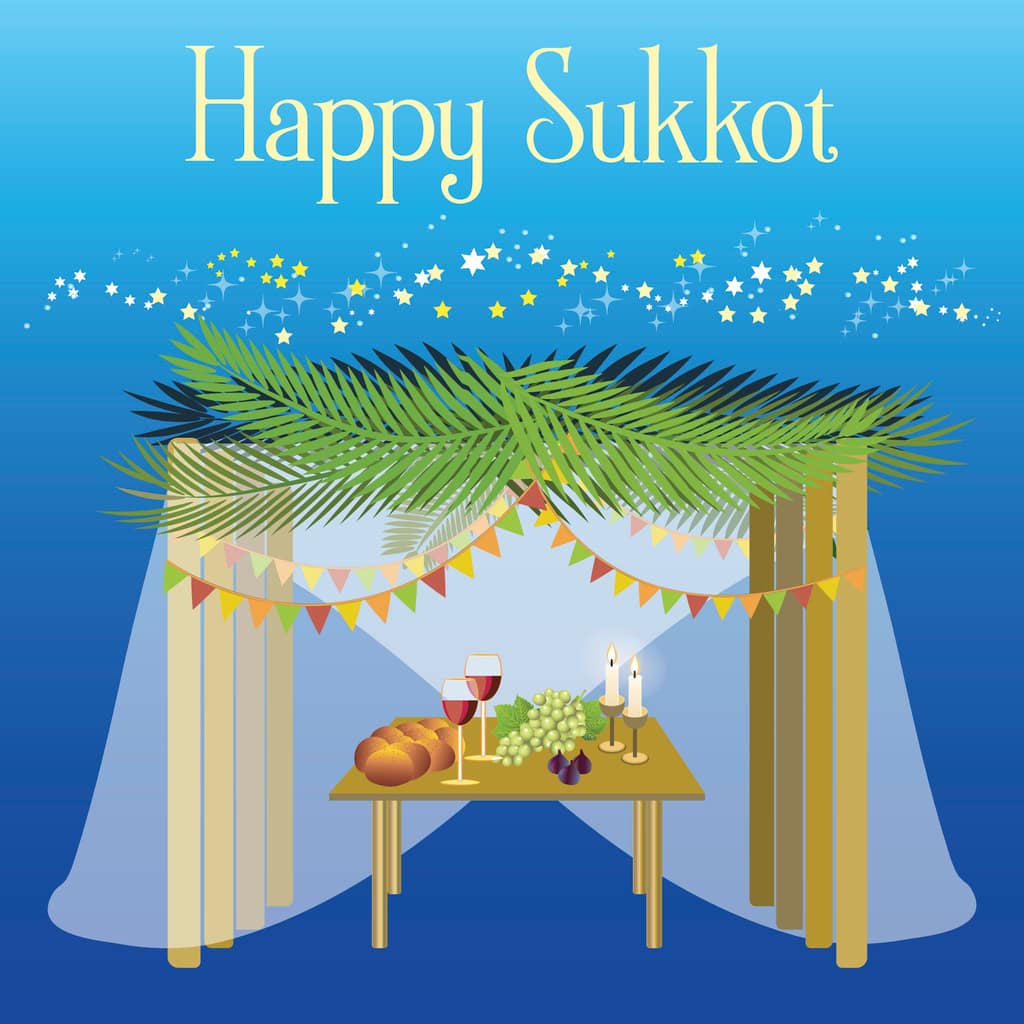
They may have sides made of tarp, latticed wood, or any other material that can stand up to the elements. The roof should be made of organic material, such as bamboo or tree branches, and should allow you to see the stars through it. Sukkahs will often be decorated with flowers, leaves, fruit, or any other memento of nature.
Families may build sukkahs in their backyard or on a deck/balcony/patio (as long as said space is not already under cover of a roof of any kind). Usually synagogues will erect a sukkah for use by congregants during the holiday. It is considered a mitzvah, or a good deed, to dwell in a sukkah during Sukkot. Therefore, those who are unable to build their own sukkah will commonly take part in a meal at a communal sukkah and/or a sukkah hosted by friends or family.

What are the Lulav and Etrog?
We also participate in a ritual called shaking the lulav and etrog. As it is said in Leviticus Ch. 23:40, “On the first day you shall take the product of hadar trees, branches of palm trees, boughs of leafy trees, and willows of the brook, and you shall rejoice before the Lord your G-d seven days.” We clasp three types of branches together: a palm frond, three myrtle twigs, and two willow branches – this assemblage is called the “lulav.” In our other hand, we hold an etrog, a citrus fruit related to the lemon. We hold the lulav and etrog close together and shake them in a specific series of movements, as our way of rejoicing in the fall harvest that G-d has granted.

Do Jews Work on Sukkot?
Sukkot officially lasts seven days; observant Jews will refrain from going to work on the first day and the eighth day. As it is said in Leviticus Ch. 23:41, “You shall observe it as a festival of the Lord for seven days in the year…” And Ch. 23:35 – 36, “The first day shall be a sacred occasion: you shall not work at your occupations….On the eighth day you shall observe a sacred occasion…you shall not work at your occupations.”
Why was Sukkot 2020 more meaningful to me?
This year, Sukkot was a bit unusual in that friends and different families were unable to congregate together in a sukkah. Nevertheless, the holiday was quite meaningful to me, for a few reasons: I was able to actually shake the lulav for the first time ever, and I was able to enjoy time in two different sukkahs!
I had previously seen a lulav only a couple times as part of a synagogue sukkah gathering, but I had not actually shaken one myself before. This year, I officially joined a congregation for the first time in my life. The synagogue offered lulav and etrog sets for purchase, and I decided to purchase one for my very own! I was so excited when I received it: the leaves were so fresh and full of life, the myrtle was exceedingly fragrant, and the etrog smelled like a fresh lemon.
Services took place virtually, of course, but as part of services, our Rabbi went over the how-to’s of how to shake the lulav. Then came the moment I’d been waiting for: waving this illustrious symbol in all directions, knowing that I was participating in a ritual practiced by Jews for thousands of years.
Not only was I able to do so at home, but I was also able to perform the mitzvah in the sukkah (yay)! This synagogue had a communal sukkah, with time slots available to reserve for socially distanced visits. I took advantage of the opportunity and was able to actually shake a lulav within the sukkah outdoors. Later that week, I paid a visit to the local Chabad synagogue (which I hold dear) and again shook the lulav and said the blessings under a sukkah dwelling. I felt very fortunate to have these opportunities even at a time when festivities were so uncertain; the holiday was even made more special by my ability to finally participate in age-old customs.

Here Comes Simchat Torah!
Immediately following Sukkot is Shemini Atzeret and Simchat Torah. On Shemini Atzeret, we say a prayer for rain, and we take a moment to remember our departed loved ones during these times of festivity.
Simchat Torah follows: this is not a biblical holiday but is quite a fun one! On this day, we finally finish reading the entire Torah (the Five Books of Moses, or the Old Testament, read over the course of one year). We celebrate this wonderful G-d-given gift by parading around the synagogue with the Torah scrolls and dancing to our heart’s delight! We then start the cycle of studying Torah all over again, since it is always wise to keep its lessons fresh in our minds. This year, we didn’t dance with the actual Torah scrolls inside the synagogue, but we did have a great Zoom dance party, dancing for a couple hours, having a blast and getting all sorts of sweaty!

Now that the holidays have come to a close, we can rest and relax for a few months, until the next holiday, Chanukah (or better known as Hanukkah)!
For more articles on the Jewish holidays, check these out:
Sources referenced and utilized:
Note: The book titles below include affiliate links to Amazon. This simply means that any purchases through these links may generate a small commission for us, at no cost to you. As an Amazon Associate I earn from qualifying purchases. More info can be found in our full disclaimer here. I personally own all of these books, consulted them for this article, and highly recommend if you’re interested in further learning. Thank you for your support!
JPS Hebrew-English Tanakh: The Traditional Hebrew Text and The New JPS Translation, Second Edition. The Jewish Publication Society. 1999.
Jewish Literacy: Revised Edition. by Rabbi Joseph Telushkin. William Morrow, HarperCollins Publishers. 1991, 2001, 2008.
The Jewish Holidays: A Guide and Commentary. by Michael Strassfeld. William Morrow, HarperCollins Publishers. 1985, 2001.
chabad.org: a wealth of information regarding all things Jewish, with an Orthodox/modern Orthodox point of view.
Cover image photo credit: IStockPhoto.com/Broken_Doll





This was wonderful to read. I was familiar with some of the verses shared but didn’t know how these were commemorated in current times. I’m glad you got to participate, even if this year has been a little unusual!
Thanks, Laura! 🙂 Glad you enjoyed the article!
This is so informative. I am more familiar with the more popularized Jewish Holidays like Hanukkah, but I think this one is beautiful. Do you think more modern Jews have forgone these traditional celebrations for more secular holidays like celebrating Thanksgiving instead? Maybe they just celebrate it within their synagogues so it isn’t made as public? Just curious why I never hear of these other special celebrations. I have another blog friend whose family celebrates both Christian and Jewish culture as they are a mixed culture family. I love how they share both with their kids.
Glad you found it useful, Sherry! I think it depends on how religious one is: many Jewish people will build a sukkah in their backyard or go to their synagogue to celebrate, and more secular Jews might not celebrate or may do so only a little. I know Hanukkah and Passover are more well known generally speaking due to their proximity to Christmas and Easter. But there are many other holidays that are little known outside the Jewish circle. That’s why I wanted to write about them, to showcase them and help others see what they’re about. 🙂