Quiz Time!
Category: I’ll take Jewish Holidays for $200!
Answer: One of the most joyous holidays in the Jewish year, when we are told to dress in costume, drink wine, and be merry!
Question: What is…Purim?
Correct! Let’s party!
Wait, wait, wait a second!…what is Purim??
Oh! Well, let me tell you a tale…
The Story of Esther
Every year, right in between Tu B’Shvat and Passover is nestled the Jewish holiday of Purim, on the 14th of Adar in the Jewish lunar calendar (usually around late February-March – this year it took place February 26, 2021). This fun-filled holiday is based on the Book of Esther in the Bible.
Here’s a quick synopsis:
During the days of the Persian empire, King Ahasuerus (pronounced “A-hajh-oo-air-us”, sometimes spelled/pronounced Ahashverosh) held a 6-month celebration. At the end of this time, during one of the final banquets, he requested his wife, Queen Vashti, to exhibit herself before his guests, so that her beauty may be displayed and admired. She refused and was hence banished from the palace.
Later, the king launched a search for a new wife. All the beautiful young maidens of the land were given the chance to come before the king. A young girl called Esther won his favor and became queen. Esther was Jewish, but under the advice of her cousin and guardian Mordecai, did not reveal her heritage.
Haman, a minister and courtier in the empire, was soon promoted to prime minister, second only to the king. Everyone was to bow low before him as he passed by; but Esther’s cousin, Mordecai, refused to bow each time Haman passed. Haman was infuriated at this apparent show of disrespect. When Mordecai was asked, “Why do you not bow?” he responded, “I am a Jew,” and that Jews would bow to no mere man (rather only to G-d).
Incensed by his response, Haman went to King Ahasuerus and asked that a decree be set, that all Jews in the land should be destroyed on a set date; he didn’t mention the name of the people, though, only that it was a people who supposedly wouldn’t follow the king’s laws. The king agreed, putting Haman in charge of the decree. Each day was assigned a number, and a lottery was done to determine the final date, the 13th of Adar.
Mordecai communicated to Esther the nature of the decree and begged her to intercede with the king.
“Do not imagine that you, of all the Jews, will escape with your life by being in the king’s palace. On the contrary, if you keep silent in this crisis, relief and deliverance will come to the Jews from another quarter, while you and your father’s house will perish. And who knows, perhaps you have attained to royal position for just such a crisis.” —JPS Hebrew-English Tanakh (see full source listing below)
Queen Esther therefore invited King Ahasuerus and Haman to dine at a royal banquet. When asked by the king if there was any request she’d like granted, she only asked that they attend a second banquet. During this subsequent feast, the king again asked his beloved queen if she had any wish he could grant. At this time, she revealed that Haman had ordered the extermination of all the Jews in the empire, of which she was one. The king had Haman executed, and since the current decree could not be officially revoked, he directed Esther and Mordecai to issue a new edict, specifically allowing the Jews to fight against anyone who might dare to attack them.
So the Jews were able to defeat all their enemies who set out to kill them on the 13th of Adar. On the 14th of Adar (or the 15th of Adar in certain cities in Israel), when they found relief from their foes, they celebrated with feasts and merriment. For this reason, the Jewish people celebrate this day every year, and it is labeled Purim because lots, or “pur-im” in Hebrew, were drawn to determine randomly the day of destruction.
The historical accuracy of this story is unknown, but it is posited that it took place about the 5th century BC.
So How Do We Celebrate?
Purim, and indeed the entire month of Adar, is a time of extreme joy. Many Jewish folk will celebrate in a manner similar to Halloween or Mardi Gras, dressing up in costume, “hiding” ourselves. (This specifically references that the hand of G-d was “hidden” in the Purim story, working behind the scenes rather than front and center with supernatural miracles. In fact, the name of G-d does not appear even once in the Book of Esther.) A special meal will be held, with lots of wine! The saying is that you are to get so drunk you cannot distinguish between “Blessed be Mordecai” or “Cursed be Haman”!

Of course the holiday is not just about drinking for your own merriment. We are to listen to the Story of Esther in its entirety, otherwise known as the “megillah,” to fully remember the tale. Jews will send gifts of ready-made food (or “mishloach manot”) to friends and family, and extra charity to the poor and needy (“mattanot le-evyonim”).
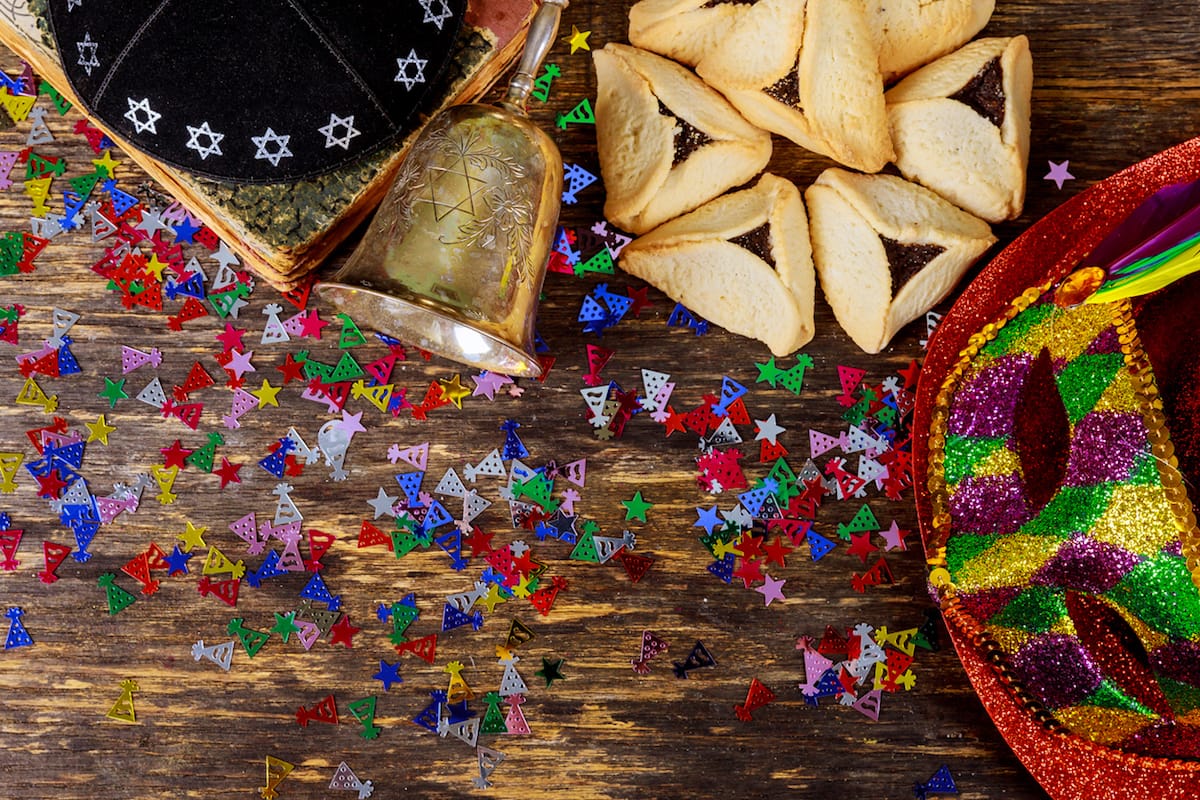
Quite a few Jewish holidays are associated with particular foods, and Purim is no exception. We love to make hamantaschen, named for, you guessed it, Haman! These are delicious triangular cookies filled with all kinds of fillings. The story goes that the shape of the cookies comes from Haman’s three-cornered hat, and also that his ears were a bit triangular in nature (although both of these are just legend). It’s common to use a white dough (similar to that of a sugar cookie) with fruit filling (like raspberry or apricot jam/pie filling), or poppyseed or prune filling; chocolate dough with peanut butter or Nutella as a filling works great too (and is delicious!).

Many Jewish communities and congregations will put on skits acting out the Purim story, intended to be fun and enjoyable for all. During the actual megillah reading itself as well as the skits, it is customary to drown out the name of Haman each time it is pronounced, via groggers (noisemaker rattles), booing, stamping one’s feet, etc. As you can probably gather, the reading and skits are very festive and animated!
The Hidden Hand of G-d
As you can see, there’s a lot to celebrate on Purim. The Jewish people were saved from destruction in the enormous Persian empire, through the hidden hand of G-d. Esther was blessed with beauty and humility, and was made queen; as someone not only in a high position but also truly loved by the king, she was also blessed with the ability to essentially reverse the evil decree. It might be chance that everything happened in just such a way that things worked out perfectly, but it’s nice to think that G-d had a plan and everything fell into place according to that plan. I like to fancy that G-d is always working behind the scenes in our own lives, and that we are destined to follow a certain path; we may not know in advance what it is, but in hindsight we can look back in a light-bulb moment and say, ah, it all makes sense.
To all those who celebrate, I wish you a Chag Purim Sameach, or Happy Purim!
Sources referenced and utilized:
Note: The book titles below include affiliate links to Amazon. This simply means that any purchases through these links may generate a small commission for us, at no cost to you. As an Amazon Associate I earn from qualifying purchases. More info can be found in our full disclaimer here. I personally own all of these books, consulted them for this article, and highly recommend if you’re interested in further learning. Thank you for your support!
JPS Hebrew-English Tanakh: The Traditional Hebrew Text and The New JPS Translation, Second Edition. The Jewish Publication Society. 1999.
Jewish Literacy: Revised Edition. by Rabbi Joseph Telushkin. William Morrow, HarperCollins Publishers. 1991, 2001, 2008.
The Jewish Holidays: A Guide and Commentary. by Michael Strassfeld. William Morrow, HarperCollins Publishers. 1985, 2001.
Cover image photo credit: IStockPhoto.com/photovs





Thanks for sharing this! While I’m familiar with the story of Esther, I was unaware of this Jewish holiday. So neat.
Glad you enjoyed reading about it, Laura! 🙂