During this past week, Jews all over the world celebrated one of the most widely-known holidays both inside and outside of the Jewish sphere: Hanukkah (also spelled Chanukah, pronounced similarly but with a guttural “h” sound from the throat). Many of you might be familiar with the estimated timing of the holiday and that it’s called The Festival of Lights. But do you know what it stands for? Well, let me tell you! 🙂
Many of those who are not Jewish know this holiday usually takes place near Christmas. That’s because it occurs on the 25th of the lunar Hebrew month Kislev, which is always approximate to the month of December. Even though Hanukkah is quite popular and well known, it’s not referenced anywhere in the Torah, also known as the Five Books of Moses in the Bible. You might think that this holiday has something to do with the winter solstice. That’s actually not the case; it really occurs on the 25th of Kislev to commemorate an event that took place in Israel on that date more than two thousand years ago.
The History
In the second century B.C.E., Israel and the surrounding areas were under the rule of the Syrian kings, part of the Greek empire. In 167 B.C.E., the current king, Antiochus (pronounced “Ant-eye-ock-us” or “Ant-ee-ohk-us”), commenced a policy of forced assimilation to Greek customs and religious beliefs. Anyone who continued to practice Judaism in any form, whether it be monotheistic beliefs, kosher dietary laws, or even circumcision, was killed. (I know, harsh, right?)
A small Jewish army formed to take on the Greek soldiers. Led by Judah the Maccabee (or “hammer”), they were extremely outnumbered, but they couldn’t stand by and watch their people and their faith and lives be desecrated. They must have known that a tiny army would have no chance against what everyone knows was a quite powerful empire. Nevertheless, they rebelled and miraculously were able to win back control of Jerusalem.
When they re-entered the city where the Holy Temple stood, they found the Temple completely ravaged; non-kosher sacrifices had been made to Greek gods, the place was in shambles, and almost all of the oil necessary for temple use was contaminated. The Jewish people cleaned up the Temple, but they only had one vial of pure uncontaminated oil to burn in the temple menorah (an essential part of normal worship at the time and still symbolized by a constantly glowing [and usually now electric] “eternal flame” in every modern synagogue). They went ahead and lit it, sadly knowing that the oil would only last one day, and started the process of making ritually pure oil, which could take eight days to do. They must have been highly surprised when they noticed the next day, that the oil was still burning. Their amazement must have multiplied tenfold when, day after day, this small bit of oil continued to burn, seemingly without running out. It finally lasted a full eight days, exactly enough time till new oil became available and ready for use. This, along with the Maccabean victory, is what we celebrate today as Hanukkah: the 25th of Kislev in the year 164 B.C.E. is when the Temple was rededicated.
Our Celebrations Today
The Hanukkah Lights
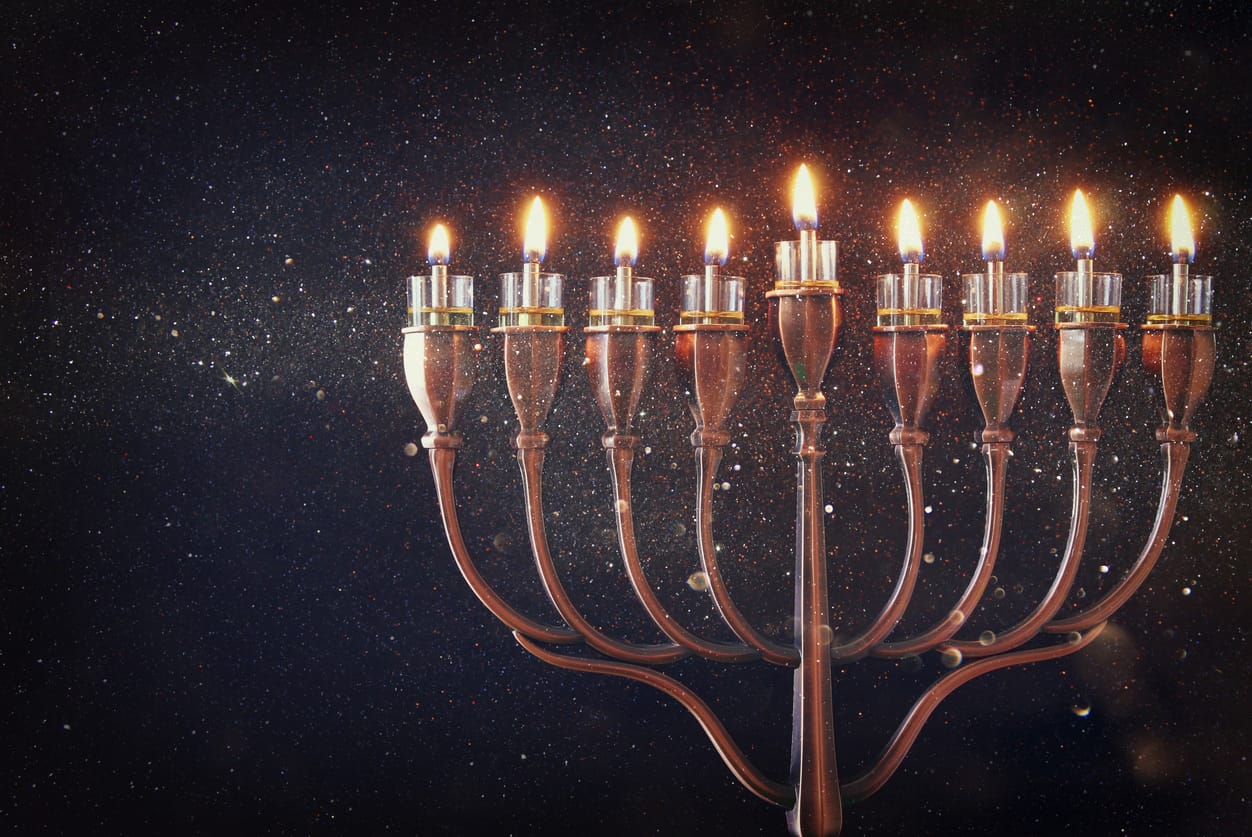
Today we follow certain traditions to celebrate Chanukah, just as prior generations did. Over the course of eight nights, we light candles in an elaborate nine-branched candle-holder, called a hanukkiah (many people call it a menorah in today’s vernacular, but that word actually refers to the seven-branched candle-holder in a temple). This is the most-practiced custom of Hanukkah; even if you don’t do anything else, if you decide to observe Hanukkah, then this is what you’ll do. Hanukkiot come in a variety of styles, from traditional to modern, from simple to elaborate. Here are past hanukkiot (the plural of hanukkiah) that I’ve used:


Last year, one of the metal pieces which actually holds the candles on my hanukkiah broke, so I had to purchase a new one. Unfortunately, it wasn’t until about two weeks before Hanukkah this year that I remembered! I hurriedly purchased the same hanukkiah and a box of candles from Bed Bath & Beyond online on Black Friday weekend. Two weeks later, my precious Chanukah supplies still hadn’t arrived – ack! Then almost like a prayer being answered, on the day prior to the holiday, the local Chabad rabbi posted on Facebook asking if anyone needed Hanukkah supplies. That same evening, I came away with a happy little hanukkiah and candles, ready for use the next evening! (Thank you again, Rabbi, you were a lifesaver!)
Like many things we Jews do, there’s a specific way to light the candles. We first light one candle that stands above the others, called the shamash or “helper candle.” We then use this candle to light the other candles. On the first night, we only light one candle besides the shamash. On the second night, we light two candles after the shamash; on the third night, three candles, and so on. The candles are placed in the hanukkiah from right to left, and we light the newest candle first, lighting left to right. As we light, we sing these blessings (in the Hebrew language):
Baruch atah, Adonai Eloheinu, Melech haolam, asher kid’shanu b’mitzvotav v’tsivanu l’hadlik ner shel Hanukkah.
English translation: Blessed are You, Adonai our God, Sovereign of all, who hallows us with mitzvot (good deeds), commanding us to kindle the Hanukkah lights.
Baruch atah, Adonai Eloheinu, Melech haolam, she-asah nisim laavoteinu v’imoteinu bayamim hahaeim baz’man hazeh.
English translation: Blessed are You, Adonai our God, Sovereign of all, who performed wonderous deeds for our ancestors in days of old at this season.
On the first night only, we add this blessing (reserved for special occasions):
Baruch atah, Adonai Eloheinu, Melech haolam, shehecheyanu v’kiy’manu v’higiyanu laz’man hazeh.
English translation: Blessed are You, Adonai our God, Sovereign of all, who has kept us alive, sustained us, and brought us to this season.
(All blessings are from the ReformJudaism.org website. To hear these blessings sung, click here.)






It’s such a beautiful sight to see the candles flickering, especially on the last night when there’s nine glowing in total. We look at these little lights and we imagine light being brought into a dark world, both literally (since we’re experiencing the shortest number of hours of daylight during the year) and metaphorically (since the world can always use more peace and kindness). It inspires us to think about what we can do personally to bring more light, joy, and compassion into the world, and to take action on that. This year, I look at my little hanukkiah, which may be simpler than the ones I’ve used in the past, but the candles still burn brightly, reminding me that no matter how small one may be, whether a person or a good deed, all are equally worthy and valid, if the spirit of the deed is the same.
Latkes, Sufganiyot, and Dreidels
Another way in which we celebrate Hanukkah is by eating delicious foods which are fried in oil, reminiscent of, of course, the miracle of the oil! (and admittedly, fried foods may not be at all healthy, but they sure do taste good, so let’s celebrate!) We cook up yummy potato pancakes, or latkes, which taste similar to fried-up hash browns in the shape of a pancake.
In past years, I always either purchased latkes from a local wonderful deli restaurant (Celebrity Delly in northern Virginia – if you’re ever in the area, give them a try – the food is amazing!), or I was able to partake at Hanukkah parties. This year, obviously I couldn’t go to gatherings, so I decided to try a second attempt at making them myself (the first time some years back without a recipe didn’t go so well – I tried frying scoops of mashed potatoes, big mistake!). It turns out you really do need to use shredded potato. You combine said shredded potato, shredded onion, egg, salt, and pepper, and then scoop a spoonful onto your griddle and fry up till it’s a wonderful golden brown…mmm….. The tradition is to eat these with sour cream or applesauce, but they’re also good with simple ketchup. My attempt this year turned out wonderfully! I used a local congregant’s family recipe, but you can find typical latke recipes here or here.


We also partake of sufganiyot, or jelly-filled doughnuts (another item fried in oil!). I haven’t made my own sufaniyot, but I usually purchase doughnuts from a store or get them at a local party (the latter prior to 2020). 2020 didn’t stop me from buying filled doughnuts at the local store, though – raspberry, lemon, glazed, oh my!

A traditional children’s game is to spin the dreidel, a small four-sided top with different Hebrew letters on each side. The letters, Nun, Gimel, Hay, and Shin, stand for Nes Gadol Haya Sham, or “A great miracle happened there.” Each player contributes a small item (usually a candy or possibly Hanukkah “gelt,” those little chocolate coins) into the “pot” and takes a turn spinning the dreidel, and depending on which side lands facing up, they can either take some of the pot, have to contribute more to the pot, or do nothing. The game ends when all except one person have no more items left. I still have my childhood dreidel with which I played with my dad as a kid.





The Magic of Chanukah
Like all the other Jewish holidays, Hanukkah represents something to be thankful for. It may not be a Biblical holiday, but it reminds us to be grateful for past miracles, and it inspires us to shine a little extra light where it may be needed, in our lives and in the world. Maybe if we all try a little more to add a spark of brightness and goodness in our spheres, peace can eventually reign.
Wishing you all a joyous holiday season!
Sources referenced and utilized:
Note: The book titles below include affiliate links to Amazon. This simply means that any purchases through these links may generate a small commission for us, at no cost to you. As an Amazon Associate I earn from qualifying purchases. More info can be found in our full disclaimer here. I personally own all of these books, consulted them for this article, and highly recommend if you’re interested in further learning. Thank you for your support!
Jewish Literacy: Revised Edition. by Rabbi Joseph Telushkin. William Morrow, HarperCollins Publishers. 1991, 2001, 2008.
The Jewish Holidays: A Guide and Commentary. by Michael Strassfeld. William Morrow, HarperCollins Publishers. 1985, 2001.
Cover image photo credit: IStockPhoto.com/tomertu


